5 November 2025
LUNÄ Talk: Turbid Ecologies
ENACT Festival - LUCA, Enough Room for Space, BE
LUNÄ Talk: Turbid Ecologies
ENACT Festival - LUCA School of Arts, Brussels
(This event is fully booked. For the reserve list, email enoughroomforspace@protonmail.com)
Location: Enough Room for Space, Sterstraat 10, Drogenbos, BE
Time: 14:00 - 19:00 (limited capacity, rsvp only)
13:30 Welcome and short introduction to Enough Room for Space
14:00 - 17:00 LUNÄ Talk
17:00 - 19:00 Dinner and drinks
(vegan & vegetarian, please inform us about allergies before so we can make the necessary adjustments to the menu)
Contributors: Merve Bedir, Marjolijn Dijkman, Ifor Duncan, Shivant Jhagroe, Annelies Kuypers
Hosts: Marjolijn Dijkman and Maarten Vanden Eynde
_
ENACT Festival - Performing Research
Organized by LUCA's Arts & Society expertise network, ENACT Festival presents innovative forms of transmission of research methodologies. Together, we will explore the exposition of artistic research as itself an epistemic practice. Known for developing innovative methodologies, artistic researchers also develop creative ways to perform their research.
ENACT invites audiences to engage with the diverse worlds, methodologies, and forms of expression of artistic inquiry. In a week of participative performances, sonic transmissions, and open discussions, LUCA researchers and their collaborators explore fields as various as silt intelligence and Inquisitorial testimonies, live-stream forest ecologies and reworkings of folk traditions, and the means through which this research is communicated. Join us for a week of participatory performances, open conversations, and unexpected encounters. ENACT is not just a festival, it’s a transmission of ideas between and via artistic research(ers).

ENACT, festival of artistic research, LUCA School of Arts, Brussels, BE
The LUNÄ Talk on November 5th, on a full moon, will explore how Enlightenment thought, the Industrial Revolution, and colonization have shaped and influenced water bodies, tracing their material and immaterial residues in sediment and flow. The discussion will critically address current practices of water “management” and the paradigm shifts needed to restore both aquatic ecosystems and our relations with the more-than-human world.
The free-flow conversation will feature contributions from Merve Bedir, Marjolijn Dijkman, Ifor Duncan, Shivant Jhagroe, and Annelies Kuypers, initiating an interdisciplinary dialogue on water, ecology, and the politics of interdependence across human and more-than-human worlds. It will connect perspectives from architecture, art, anthropology, and political ecology, exploring how infrastructures, environments, and technologies shape collective belonging, memory, and justice. The LUNÄ Talks invite the contributors and audience to rethink the relationships between materiality, power, and environmental transformation, ranging from silt and mud to algorithms and governance.

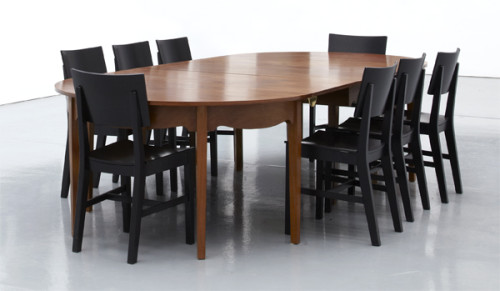
LUNÄ (Marjolijn Dijkman, 2011 – ongoing) is an art installation and conversation piece that references the legacy of the 18th-century Lunar Society of Birmingham—a group of enthusiasts and lay scholars who met on full moon nights to discover and discuss new ideas. The ‘Lunatics,’ as they were called, transformed science and changed the world. They built theories, engines, and invented machines and ideas. They altered the face of their time. Three centuries later, LUNÄ revisits this moment of historical significance. A facsimile of the original table where Lunar Men met provides a critical context for speculating and expanding on topics the original society possibly discussed, as well as exploring new ideas within these fields. Each conversation, in sync with the full moon, will feature a high tide of ideas, concepts, and questions, instigating concordances between what is current and exciting in science, philosophy, and the social imagination.
Confirmed contributors:
Merve Bedir is an architect whose practice engages with infrastructures of hospitality and mobility. A second line of her work focuses on collective intelligences and imaginaries of landscape. She is a co-founder of Aformal Academy in the Pearl River Delta Region, Mutfak مطبخ Workshop in Gaziantep, and the Center for Spatial Justice in Istanbul. Her work has been presented internationally, including BAK (2023), Smithsonian Design Museum (2023), Venice Architecture Biennale (2021), Matadero Madrid (2020). She curated/convened Wetness in Saltonline (Istanbul, 2025), Vocabulary of Hospitality (Studio X Istanbul, 2014; Gemaal op Zuid, Rotterdam, 2019), Automated Landscapes (UABB Shenzhen 2017 and 2019), uncommon river (OAW, Plovdiv, 2015). She is the editor of the New Silk Roads series on e-flux Architecture and has contributed to publications such as Harvard Design Magazine and The Funambulist. Merve holds a PhD from Delft University of Technology and a BArch from Middle East Technical University. She has taught design studios related to wetness, borders and territories, repair and posthuman agency at the University of Hong Kong, École Polytechnique Fédérale de Lausanne, and Columbia GSAPP. Her projects were reviewed in The Guardian, The Avery Review, and Frieze.
Marjolijn Dijkman is a research-based, multidisciplinary artist who works with film, photography, sculpture, and installation. Her practice explores the intersection of culture and other fields of inquiry, strongly focusing on the rapidly changing environment and its human and nonhuman interdependencies. She co-founded Enough Room for Space (ERforS) in 2005, fostering collaborations across art, science, and activism. Currently a Ph.D. researcher at LUCA School of Arts, Brussels & KU Leuven, she is also an artist-in-residence with the EU Horizon project WaterLANDS (2023–2026) and section editor of Commodity Frontiers Journal. Her current research project, Turbid Tides, explores the parallel between rising siltation in the Ems-Dollard estuary and the expanding influence of computational thinking, with silt and data as its protagonists.
Ifor Duncan is a Postdoctoral Researcher on the EcoViolence ERC project at Utrecht University. His interdisciplinary research and art-practice focus on political violence in the contexts of devastated river systems and dispossessed communities. He approaches the weaponisation of rivers as borders, in the installation of hydropower, and as the mediums and dynamic archives of genocide through cultural memory and an audio-visual practice that involves submerged methods. Ifor has a PhD from the Centre for Research Architecture, Goldsmiths, where he was also Lecturer, and has been a Postdoctoral Fellow in Environmental Humanities at NICHE, Ca' Foscari, University of Venice.
Shivant Jhagroe is an Assistant Professor at the Institute of Public Administration of Leiden University, in the Netherlands. His work revolves around sustainability governance, inequality, climate justice, and decolonisation. He is particularly interested in the role of novel governance arrangements around sustainability and digital technology, focusing on questions of knowledge/power, inequality, and justice. In 2024, his book Beyond Sustainability (in Dutch, Voorbij Duurzaamheid) was published, which critically examines western-centric sustainability narratives and explores radically just and democratic futures. In his current work, he also examines ‘eco-belonging’ in Global North regions through a decolonial lens, focusing on lived experiences, cultural narratives, and political agency.
Annelies Kuypers is an anthropologist studying human-environment relations through water and materiality. As a postdoctoral researcher at the Université Libre de Bruxelles (LAMC), she leads the FNRS-funded project “Mud Matters!” on the long-term aftermath of the 2021 floods in Belgium, Germany, and the Netherlands. Her earlier PhD research in southeast Turkey examined how dam construction along the Euphrates transformed local ecologies and relations with the river. Her work engages with the anthropology of water, ecology, climate change, and posthumanist and multi-species perspectives.